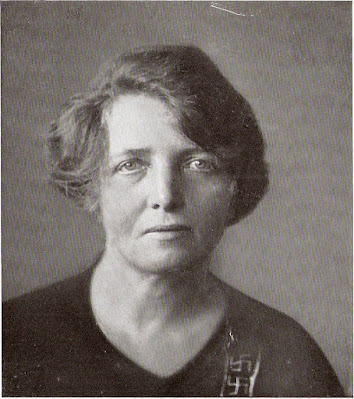
Ethical Pluralism (a new Mathilde Ludendorff) and freewill versus determinism
Ethical Pluralism and the Debate Between Free Will and Determinism: Navigating Choice, Necessity, and Moral Fulfillment in a Plural RealityIntroduction: The Perennial Tension of Agency in Philosophical ThoughtThe debate between free will and determinism stands as one of philosophy's most enduring conundrums, probing the nature of human agency, moral responsibility, and the structure of reality itself. Free will posits that individuals possess the capacity for genuine choice, independent of causal chains—enabling authentic decision-making and ethical accountability. Determinism, conversely, asserts that all events, including human actions, are the inevitable outcomes of prior causes, governed by laws of nature, physics, or divine predestination, rendering "choice" an illusion. This tension has permeated Western thought from ancient Stoics and Epicureans to modern compatibilists (e.g., David Hume) and incompatibilists (e.g., Baron d'Holbach's hard determinism vs. William James' libertarianism), influencing theology (e.g., predestination in Calvinism), science (e.g., Laplace's deterministic universe), and ethics (e.g., if no free will, no true morality).Ethical Pluralism, a contemporary philosophical system reconstructed from purified metaphysical insights, engages this debate by reframing it within its ontology of irreducible plural essences—independent modes of being such as persistence (replicative continuity), finitude (programmed termination enabling renewal), transformation (contingent adaptation without teleology), consciousness (reflective awareness), aspiration (strivings toward ethical, aesthetic, epistemic, and relational values), transcendence (experiential elevation beyond time, space, and causality), moral discernment (intrinsic evaluation of actions), and relational fulfillment (discerning bonds of affinity and distinction). These essences coexist without any common aspect, unifying principle, substrate, or hierarchical purpose, interacting only contingently to generate existence's dynamic mosaic. Drawing evidentiary support from quantum mechanics' probabilistic indeterminacy (e.g., superpositions defying classical causality) and evolutionary biology's contingent branching (e.g., random mutations yielding diversity without predetermined direction), Ethical Pluralism derives ethics not from deterministic laws or libertarian absolutes but from the intrinsic affirmation of these essences via "God-Cognisance"—an experiential awareness that evokes awe at plurality's depth and fosters fulfillment amid diversity, free from dogma or imposed necessity.This essay explores how Ethical Pluralism relates to the free will-determinism debate, highlighting convergences in acknowledging contingency and human responsibility, while underscoring divergences in their treatment of causality (strict chains vs. super-causal independence), agency (absolute freedom vs. discerning navigation), and moral grounding (choice in void vs. affirmation of essences). Through sections on metaphysics, epistemology, ethics, and implications, we discern how Pluralism offers a pluralistic resolution to the debate, complementing libertarian emphases on choice with deterministic insights into necessity, while transcending both through experiential affirmation. Ultimately, their relation illuminates a path where free will emerges not as illusion or absolute but as moral discernment amid irreducible multiplicity.Metaphysical Relations: Deterministic Causality, Libertarian Freedom, and Plural IndependenceThe free will-determinism debate hinges on metaphysics: Determinism, in its hard form (e.g., physical determinism via Newtonian laws or Laplace's demon), views reality as a closed causal chain—every event necessitated by antecedents, leaving no room for uncaused choices. Soft determinism (compatibilism) reconciles this with free will by redefining freedom as acting according to one's desires, even if determined (e.g., Hobbes). Libertarianism counters with metaphysical freedom—uncaused actions via agent causation (e.g., Chisholm) or indeterminism (e.g., Epicurean atomic swerves)—positing a non-deterministic reality where choices break causal chains.Ethical Pluralism engages this by bifurcating reality into "inside spacetime" (visible essences governed by causality, akin to deterministic phenomena) and "outside spacetime" (invisible essences as super-causal, aligning with libertarian transcendence). Visible essences like transformation (evolutionary change via causal mutations) affirm determinism's chains—quantum mechanics' classical limit (macro-determinism) supports this. Yet, invisible essences like transcendence (timeless states) and moral discernment (evaluation beyond causality) introduce libertarian independence—quantum indeterminacy (micro-level probabilities) echoes this super-causality, where essences interact contingently without deterministic necessity.Convergences: Pluralism's plurality resolves the debate's antinomies—determinism in visible (causal survival), libertarianism in invisible (super-causal aspiration)—mirroring compatibilism's reconciliation but without redefinition. Existentialist influences (e.g., Sartre's freedom in absurdity) parallel Pluralism's contingent interactions without teleology. Divergences: Determinism's unity (causal web) and libertarianism's absolute freedom are critiqued—Pluralism affirms absolute separation, where causality is one essence among many, not totalizing. No "swerve" needed; plurality inherently indeterminant.This metaphysical relation reframes the debate: Pluralism complements by pluralizing causality/freedom into coexistent essences, offering a metaphysics where agency navigates multiplicity without illusion or absolutism.Epistemological Relations: Existential Insight and the Limits of Deterministic ReasonEpistemologically, determinism relies on rational-empirical knowledge: If all is caused, truth derives from tracing chains (e.g., scientific laws). Libertarianism emphasizes subjective experience—knowledge of freedom via introspection (e.g., feeling of choice). Existentialism bridges: Insight from confronting absurdity/freedom.Ethical Pluralism echoes libertarian/existential experientialism: Reason limits to visible essences (causal phenomena); invisible demand intuition/transcendence—God-Cognisance as apprehension of plurality beyond determinism. Discernment enables this, affirming libertarian choice without absolute freedom—quantum intuition (probabilities) parallels indeterministic insight.Convergences: Both critique deterministic reason—debate's hard determinism as limiting (no free knowledge); libertarian intuition mirrors discernment. Divergences: Determinism's objective chains contrast Pluralism's experiential plurality; libertarian absolutism as overreach—Pluralism's discernment qualifies choice contextually.Pluralism complements the debate epistemologically: Affirms deterministic empiricism in visible, libertarian intuition in invisible.Ethical Relations: Responsibility in Freedom Versus Intrinsic AffirmationThe debate's ethics hinge on agency: Determinism undermines responsibility (no true choice, no blame—e.g., compatibilist "could have done otherwise if desired"); libertarianism grounds it in uncaused will (moral accountability via freedom).Ethical Pluralism derives ethics from essence-affirmation: Intrinsic goodness affirms plurality without purpose—discernment evaluates, enabling responsibility amid contingency. Affirms libertarian freedom (discernment as choice) but qualifies with deterministic elements (visible causal duties)—ethics as harmonious navigation.Convergences: Both emphasize agency—libertarian responsibility parallels discerning affirmation; compatibilism's redefined freedom echoes contextual ethics. Divergences: Determinism's no-blame critiques moral absolutism; libertarianism's absolute will as imposition—Pluralism's intrinsic, non-purposeful.Pluralism resolves: Affirms responsibility through discernment, transcending the debate.Implications: Pluralism's Resolution to the Free Will-Determinism TensionIn modern science (quantum indeterminism challenging classical determinism), Pluralism complements the debate—pluralizing causality/freedom into essences. Ethics derive experientially, offering fulfillment beyond anguish.Conclusion: Pluralism as the Debate's Pluralistic SynthesisEthical Pluralism relates to free will-determinism as a reconciling multiplicity: Complements libertarian agency with deterministic contingency, deriving ethics from affirmation. This fosters a nuanced view—agency as discerning plurality, guiding moral fulfillment amid uncertainty.

Comments
Post a Comment