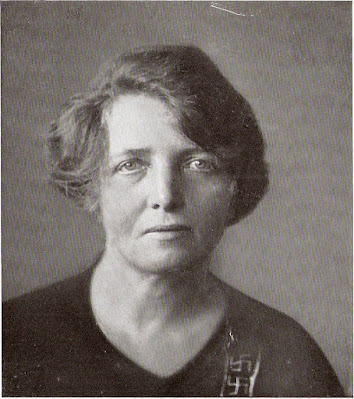
Elaboration on what is "legacy-building" in Cosmic Rationalism (Mathilde Ludendorff reimagined)
The Role and Further Elaboration of Legacy-Building in Cosmic RationalismIn a universe characterized by probabilistic emergence and inevitable transience, the quest for enduring significance becomes a central human endeavor. Cosmic Rationalism, a philosophical framework grounded in empirical science and emergent naturalism, posits that life's meaning arises not from supernatural mandates or inherent teleology but from adaptive processes where individuals integrate evolved instincts and capacities to navigate existence. At the heart of this ideology lies "legacy-building"—the deliberate creation of impacts that persist beyond one's finite lifespan, manifesting as genetic, cultural, relational, and ethical contributions. Reinvented from Mathilde Ludendorff's vitalistic notions but stripped of pseudoscience, legacy-building in Cosmic Rationalism serves as the antidote to nihilism, transforming death's finality into a catalyst for purposeful action. This essay explores its role as the emergent drive for meaning, elaborates its multifaceted dimensions, and examines its ethical implications, demonstrating how it empowers resilient, awe-inspired living in a dynamic cosmos.Legacy-Building as the Emergent Drive for MeaningCosmic Rationalism views the universe as a self-organizing system unfolding from quantum origins in the Big Bang to biological complexity via evolution, without divine intervention or predetermined purpose. In this framework, transience— the thermodynamic inevitability of decay and death—poses life's central paradox: Unicellular organisms achieve near-"immortality" through endless replication (e.g., via telomerase-enabled division), yet multicellularity trades this for diversity and consciousness, enabling emergent awareness but ensuring finitude. Ludendorff's "Immortal-Will" as a vital force is reframed naturalistically: It becomes the "legacy-drive," an evolved adaptation rooted in genetic persistence (reproductive success) and extended culturally through memes—ideas, art, and innovations that outlive the individual.The role of legacy-building is thus foundational: It provides adaptive meaning amid entropy's arrow. Evolutionary biology supports this—natural selection favors traits enhancing survival and reproduction, but in humans, cultural evolution (via language and tools) amplifies this into symbolic legacies. Neuroscience elaborates: Dopamine-driven reward systems motivate goal-oriented behaviors, where "legacy" acts as a long-term reinforcer, countering short-term hedonism. In Cosmic Rationalism, legacy-building integrates instincts (e.g., survival/sex) with capacities (empathy/creativity/inquiry/love-hate), fostering harmony: Genetic legacy (healthy offspring) aligns with relational bonds; cultural legacy (art/science) with beauty/truth. This drive resolves existential voids—nihilism's despair yields to rational optimism, where finite lives urge creation of enduring echoes.Elaborating the Dimensions of Legacy-BuildingLegacy-building in Cosmic Rationalism is multifaceted, elaborated across biological, cultural, relational, and ethical domains, each emergent from scientific processes.Biologically, it begins with genetic legacy: Reproduction perpetuates DNA, an evolved imperative from unicellular division to human pair-bonding (oxytocin-driven attachments). Elaborated, this includes mindful parenting—evidence-based practices like attachment theory ensure resilient offspring, extending legacy through generational adaptation. Ethically, it demands sustainability: Overpopulation or environmental degradation (e.g., climate change disrupting ecosystems) undermines future legacies, aligning with evolved stewardship (group selection favoring long-term cooperation).Culturally, legacy expands via memes—Richard Dawkins's concept of ideas replicating like genes. Art, science, and innovations endure: A painting inspires awe across centuries; scientific breakthroughs (e.g., vaccines) save billions. Elaborated, this role emphasizes "conscious genius"—integrated creativity where capacities harmonize (e.g., empathy fueling ethical AI development). Neuroplasticity enables this: Lifelong learning rewires brains, turning inquiry into legacy (e.g., open-source knowledge persisting digitally).Relationally, legacy manifests in bonds: Evolved love/hate discriminates—love fosters alliances (empathy via mirror neurons), hate resolves threats—for communal resilience. Elaborated as "minne" (spiritualized intimacy), it builds familial/societal networks: Healthy relations (via communication/therapy) create emotional legacies, enduring in shared values/memories.Ethically, legacy-building synthesizes: Actions "good" if enhancing harmony/impact (prosocial equity), "evil" if disrupting (exploitation). Elaborated morals: Duties (laws for access/sustainability) as necessities; values independent—refine via reflection (conscience as tool). "God-living" (flow states) affirms this: Neural synchrony in creation yields timeless meaning, legacy as awe's fruit.Ethical Implications: Legacy as Catalyst for Perfection and HarmonyLegacy-building's role extends ethically: In transience, it urges perfection—emergent self-actualization via growth mindsets (Carol Dweck-inspired), where neuroplasticity enables capacity integration. Myths symbolize: "Paradise lost" as aspirational resilience, "beyond" as legacy eternity. This counters utility (e.g., ambition as "virtue") for intrinsic values—legacy moral if sustainable (e.g., equitable policies fostering biodiversity).Sublime: Humans as cosmic co-creators—adapt, build impacts—transforming emergence into purpose. Politics/culture: Inclusive systems/education for legacy (e.g., sustainable tech as ethical creation).Conclusion: Sublime Legacy in an Emergent CosmosIn Cosmic Rationalism, legacy-building is the sublime emergent drive: Turning transience into meaning, integrating biology/culture into ethical harmony. Elaborated multidimensionally, it empowers resilient lives—forge genetic/cultural/relational/ethical echoes, affirming human potential in probabilistic reality. This vision transforms existence: Not futile drift, but purposeful creation—rational legacy as cosmic affirmation.

Comments
Post a Comment